Architectural project · 2008
The Cosmology Research Center
A cosmology research center shaped by fractal and spatial theory.
Design Brief#
This project explores cosmology as an architectural medium. It begins with the human effort to understand the universe—its age, origin, history, and governing principles—and translates that inquiry into spatial form.

Twentieth-century physics transformed conventional ideas of space and time. Relativity redefined gravity, quantum mechanics challenged classical certainty, and later theories sought to reconcile these systems. Their influence extends beyond science, reshaping cultural imagination, art, and design.
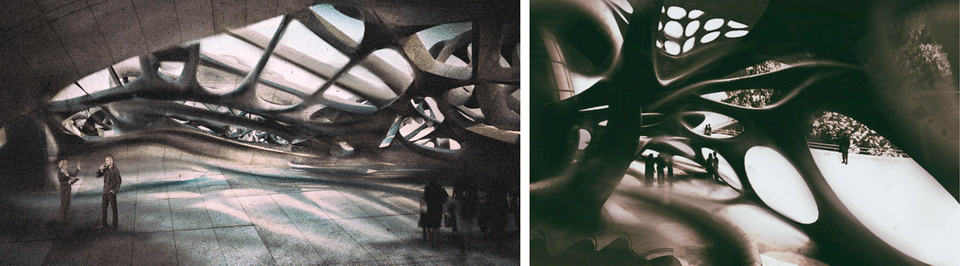
The proposal moves from the scale of the cosmos toward chaos and the micro-scale, using scientific theories as a framework for architectural exploration.
Terminology#
Hyper-Dimensionality#
The design process examines geometric systems capable of evoking a “chaotic shell of inflation.” In an isolated desert setting, the research center becomes an instrument for studying and inhabiting these ideas.
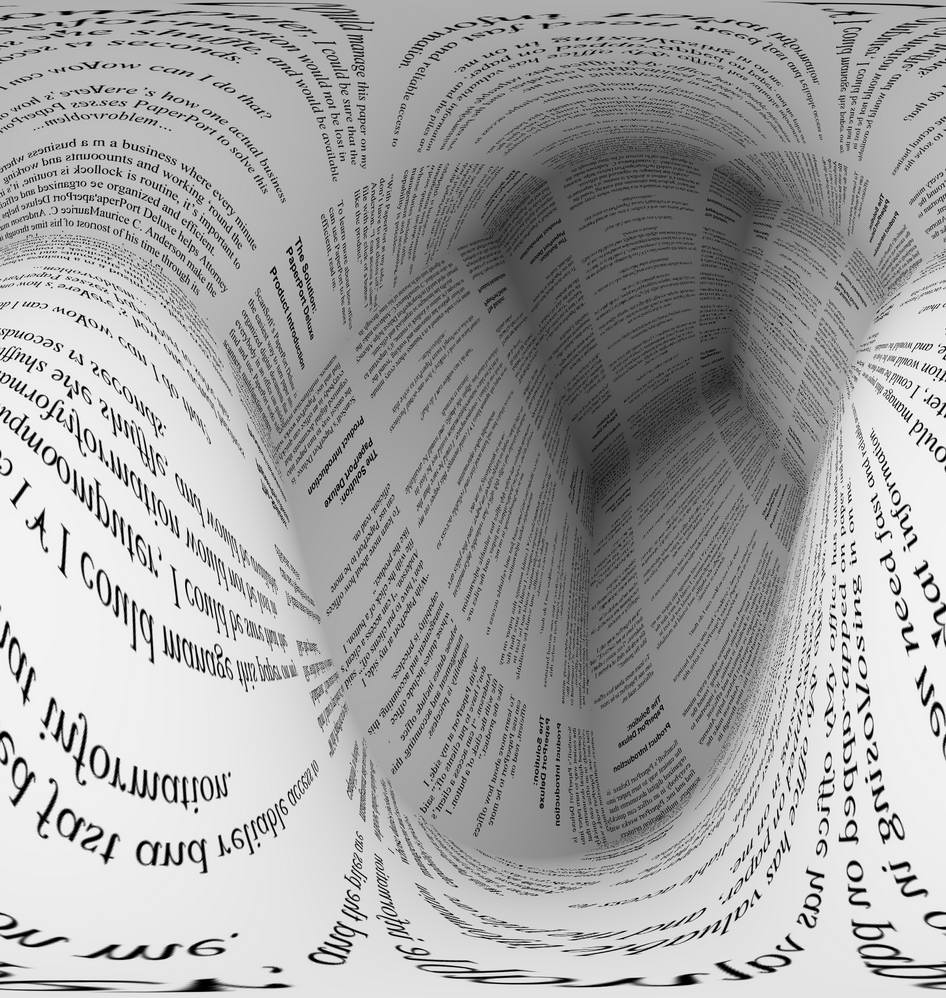
Fractal and hyperspace geometries provide a basis for this investigation. Their rules, variations, and latent dimensions inform the project’s spatial language.
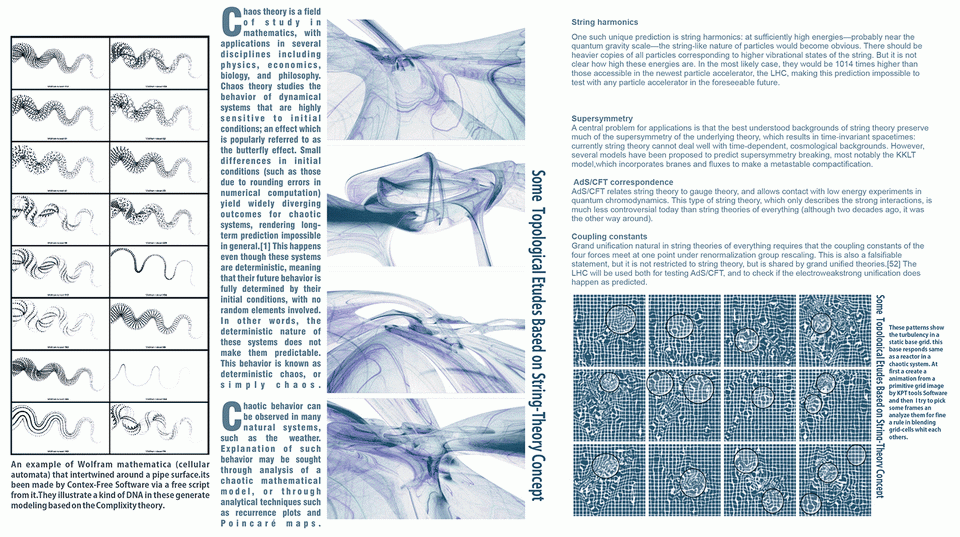
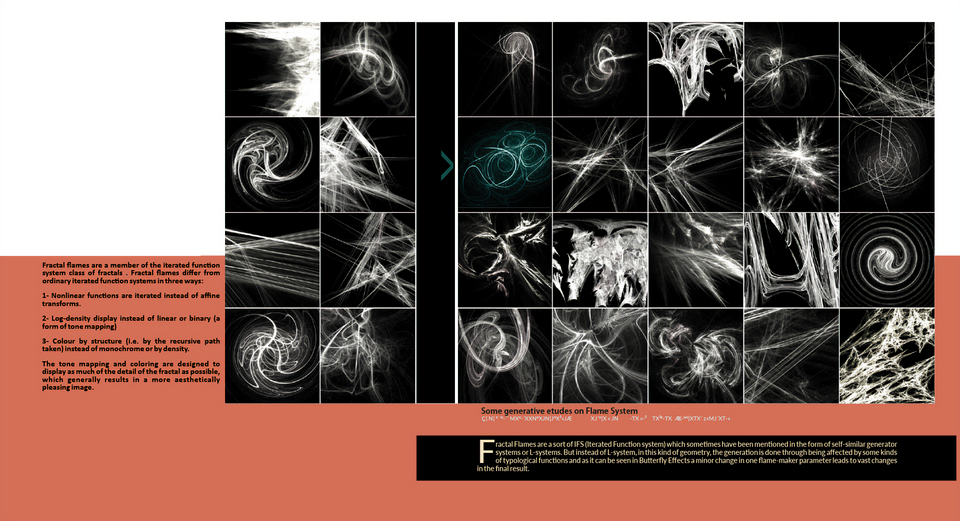
A fractal geometry, derived from chaos theory and transformed through a deformer function, generates coordinates for a form aligned with the project’s cosmological subject.#
Flame Algorithms as the Origin of the Design#
Flame geometry operates beyond conventional two-dimensional order. Although driven by controlled inputs, its iterative process produces unpredictable outcomes. This tension between logic and accident becomes central to the architecture.
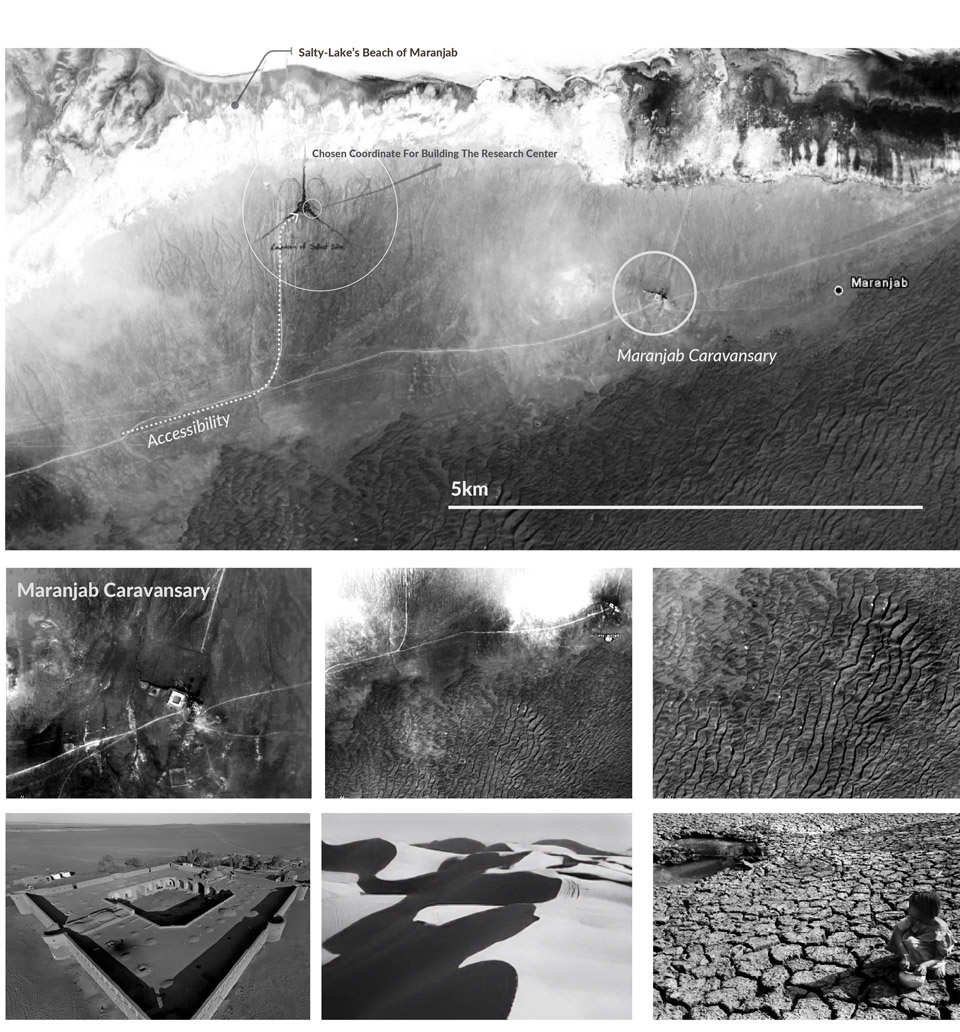
Site Location#
The desert was selected for both its physical conditions and its symbolic relationship to cosmological inquiry.
Key considerations supporting the selected location#
-
Desert Isolation#
The desert offers distance from everyday distractions and a setting for concentration, observation, and reflection.
-
Night Sky#
Its clear, expansive night sky reinforces the project’s relationship with astronomical research.
-
Vastness#
The scale and sparseness of the desert frame human existence against the larger history of the universe.
-
Water Scarcity#
The limited presence of water offers a terrestrial analogy to its relative rarity at a cosmological scale.
-
Technological Potential#
Wind and solar resources can support high-performance environmental systems with minimal conflict with surrounding settlement.
-
The Maranjab Desert#
The Maranjab Desert combines visual character, relative accessibility, and the presence of the adjacent salt lake, which changes across the seasons.
Specifications#
The project is situated in the Maranjab Desert on the central Iranian plateau. Its spatial concept draws on the cosmologist’s view of the universe as a continuous space-time manifold: a fabric in which time and space remain inseparable.

Continuous movement provides the key architectural analogy. As an object travels without disappearing and reappearing along its path, the design seeks to express continuity in circulation, form, and experience.
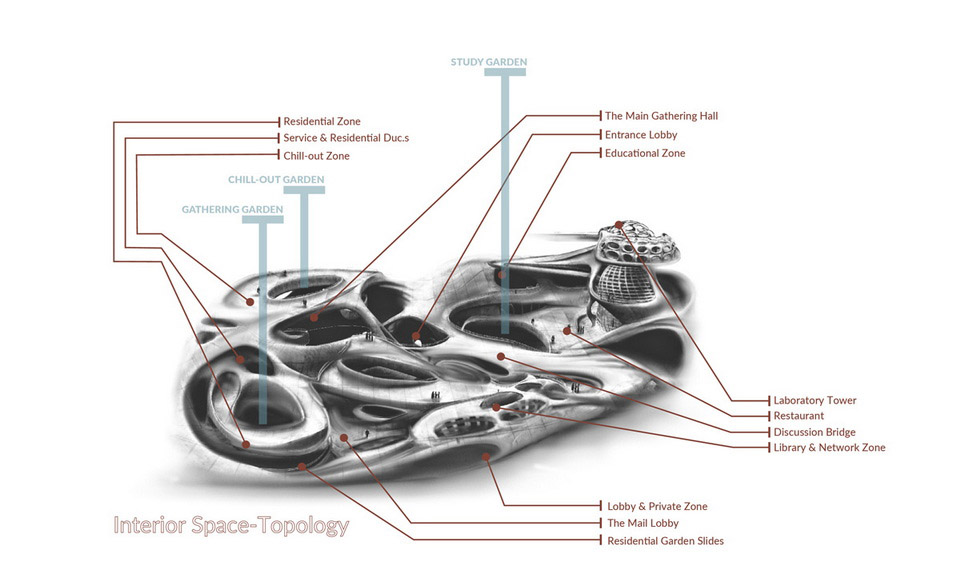
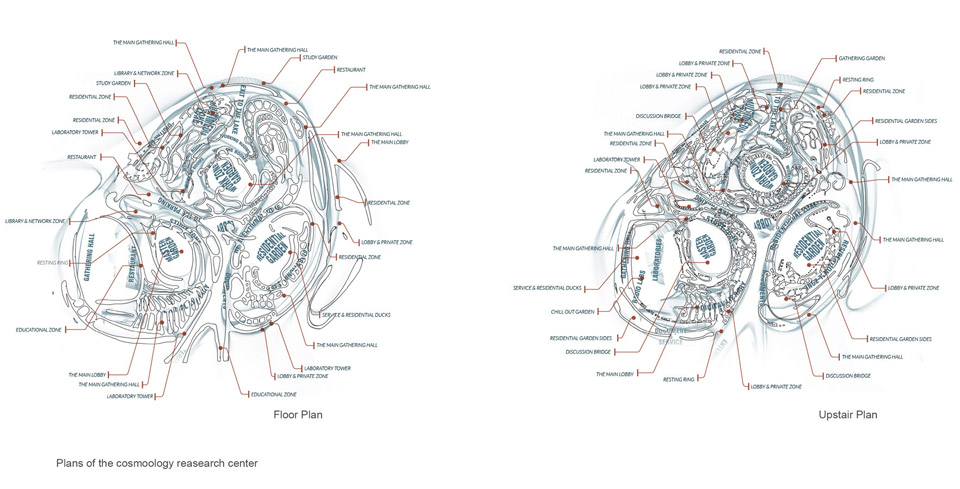
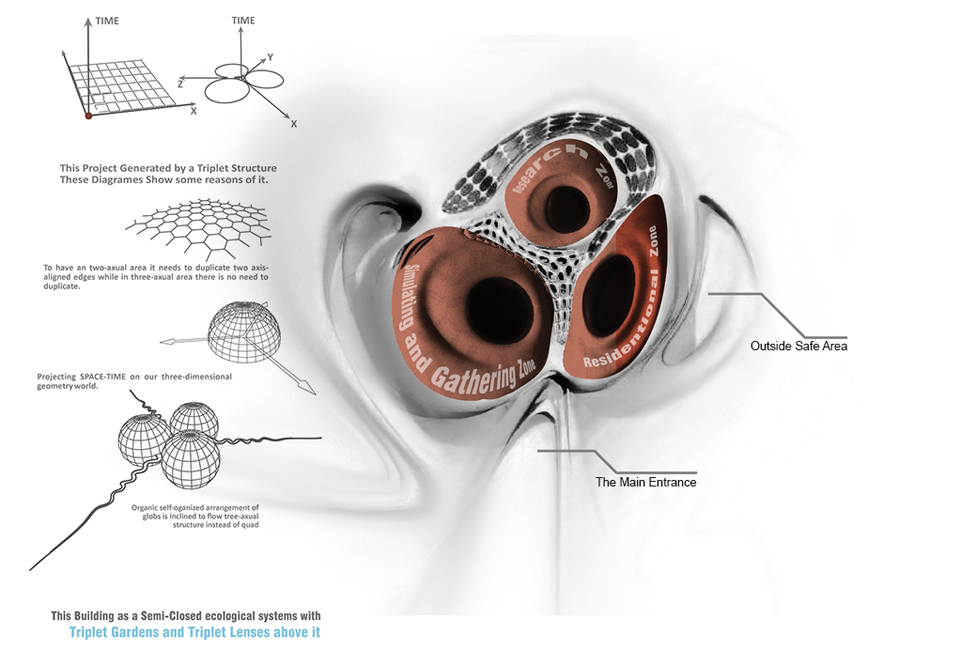
This research center comprises three primary components:
- Laboratories and libraries
- Residential facilities
- Assembly and conference halls
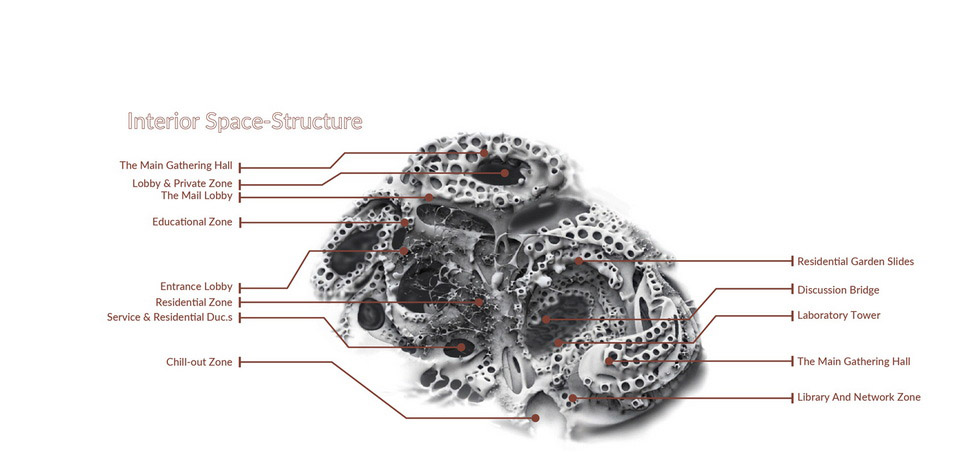
Detailed Topological View#
Gardens#
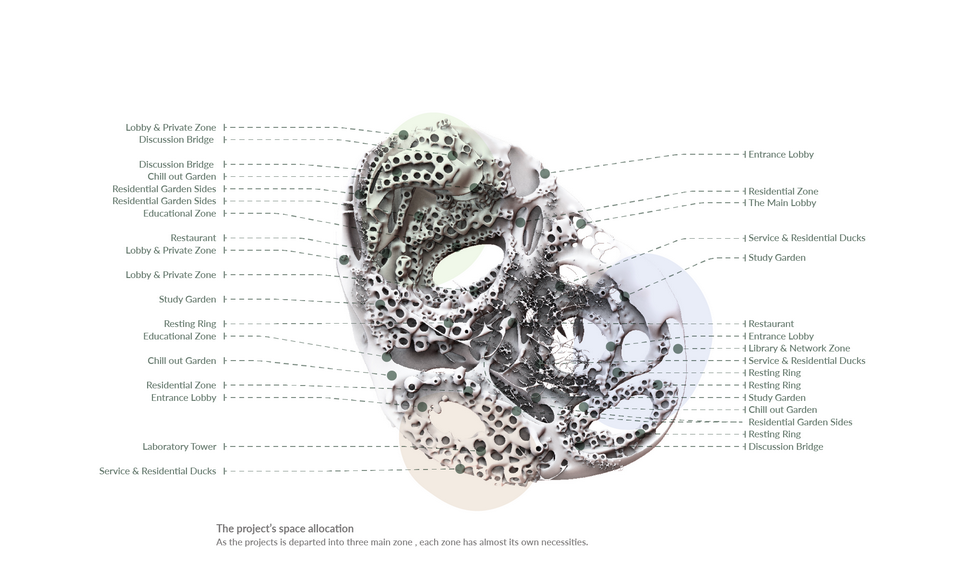
Each major component is organized around a central garden.
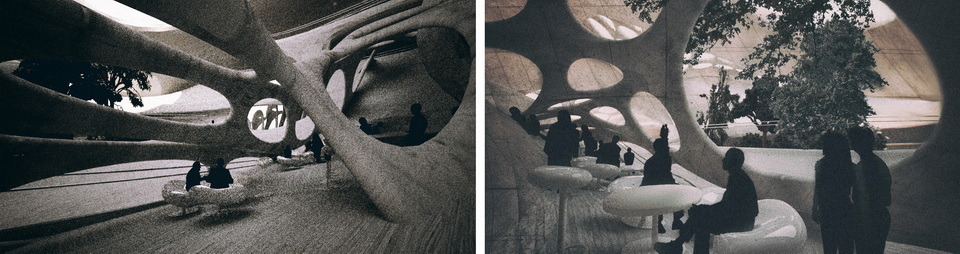
The three gardens form semi-enclosed ecosystems that maintain appropriate light, humidity, and temperature in a climate otherwise hostile to planting.#
Triple-layer glazing moderates daylight and supports controlled artificial illumination.
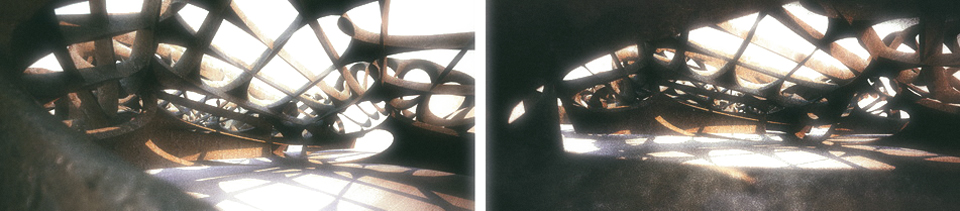
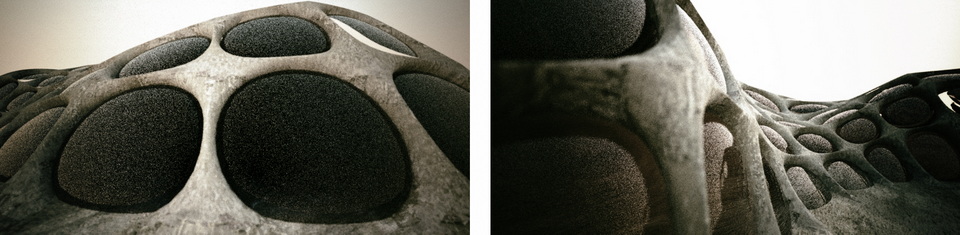
The complex consolidates the services associated with metropolitan life within a network of interconnected, bubble-like enclosures.
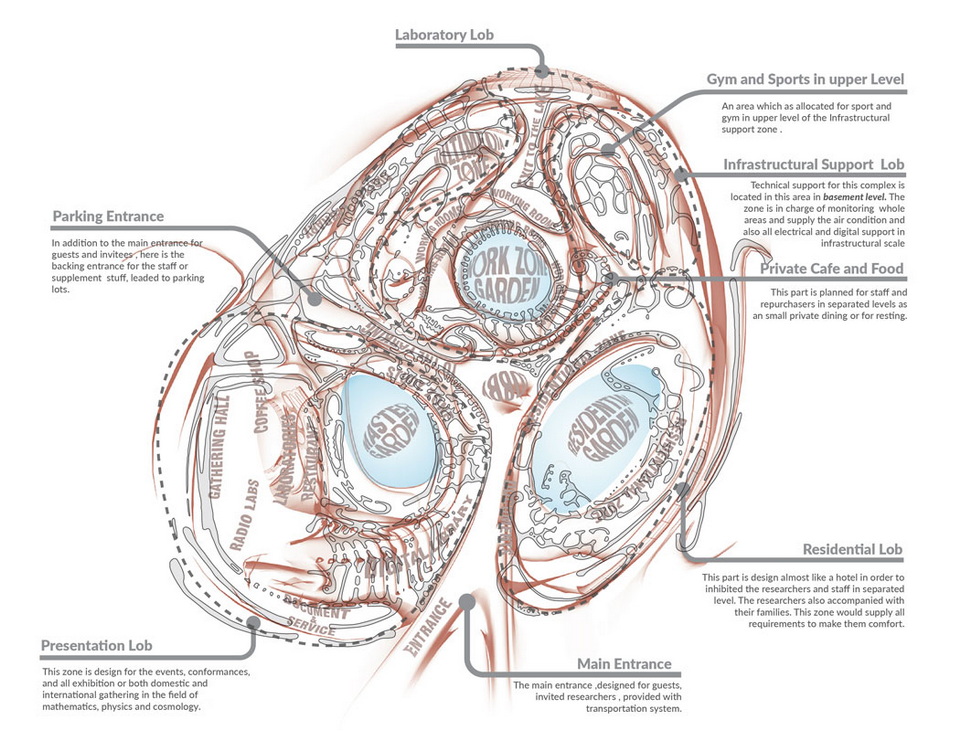
The proposal uses directional ambiguity as a deliberate spatial device. Paths, building elements, and gardens resist a single fixed orientation, encouraging exploration and intensifying the experience of movement across the site.