Studio / workshop · 2015
Evolver Studio
Computational design studio at CAAI, supervised by Helioripple
Studio Evolver was held at CAAI in fall 2015 under the mentorship of Amin Bahrami, Hooman Talebi, and Mobasher Nekouei, with Studio Helioripple—Amin Bahrami and Hoda Farazandeh—providing supervision. The program introduced a computational approach to critical architectural design through three stages: introductory, intermediate, and final. Across these stages, students worked with self-organization, data-driven design, and agent-based systems, individually or in combination.
The studio began with intensive preparation in Grasshopper and Processing. Group exercises established a shared foundation in coding, data, self-organization, and agent behavior. Students then selected a specialized topic, developed research in the field, and applied it to the design of a skyscraper. Conversations with practitioners and specialists in disciplines such as biology and sociology supported an interdisciplinary perspective on computer-based design.
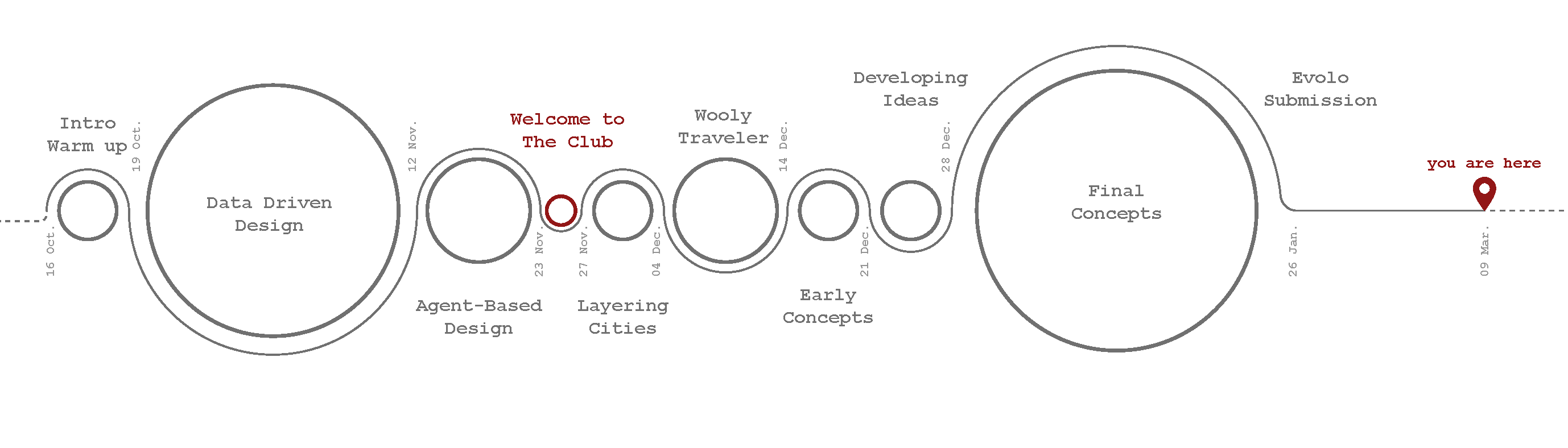
During the first five weeks and ten sessions, all three mentors worked with the students on a shared topic. The second phase divided into three sub-studios, each led by one mentor:
-
Counter Gravity#
supervised by Amin Bahrami (& Helioripple Team)
-
Stairway to heaven#
supervised by Hooman Talebi
-
Periferia#
supervised by Mobasher Nekouei
At key stages, students presented their work for review and received guidance from architects and academics. Selected proposals were tested through the eVolo competition. A defining aim of the studio was to advance design thinking through computational methods for addressing architectural problems both within and beyond their immediate context.
Data Driven Design#
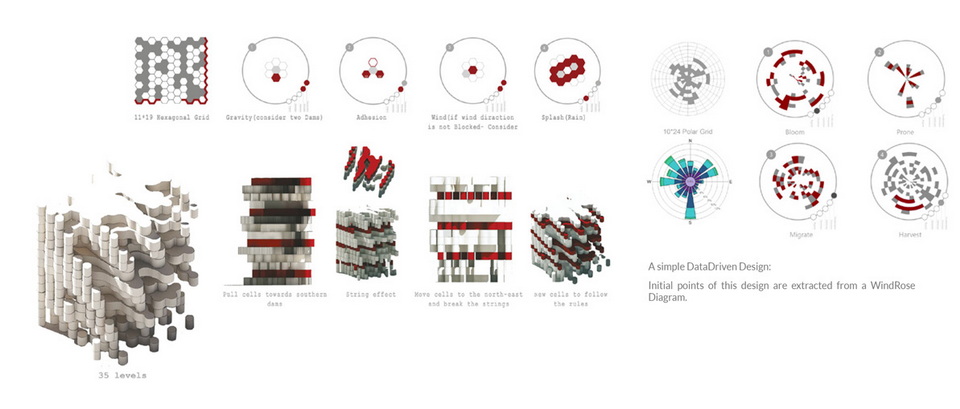
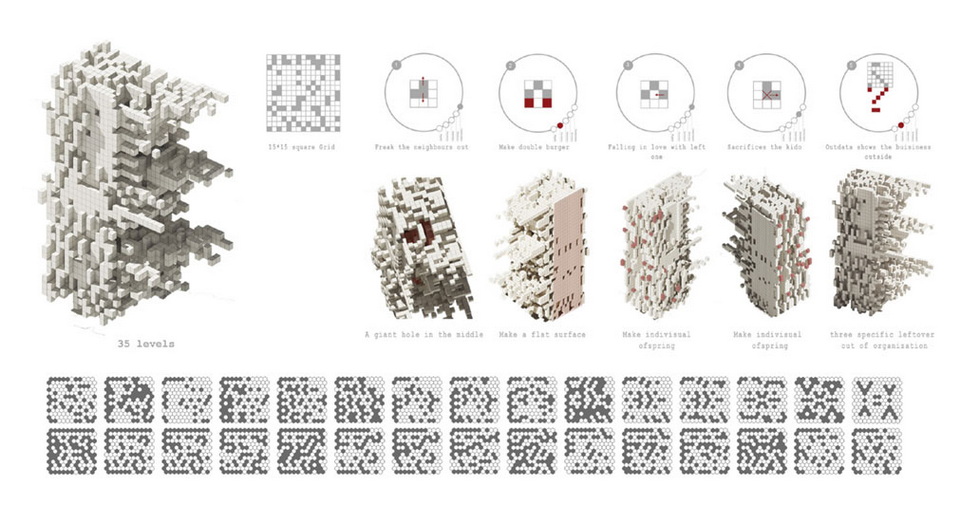
Students practiced rule-based design through two-dimensional cellular automata, including Conway’s Game of Life, using 3 × 3 grids. Each team developed rules for individual cells in response to their neighborhoods, then extruded and stacked the resulting levels. Following this initial exercise, students worked with static and dynamic data: collecting, visualizing, mapping, and applying it to self-defined grids while deriving new rules from public and personal environments. Shared cloud tools such as Google Drive introduced an early model of collaborative design.