Studio / workshop · 2017
Heteroduino II
Physical-computing workshop at CAAI, led by Helioripple
To make Arduino more useful to architects, we developed Heteroduino, an interface plugin that simplifies communication with Arduino and related microcontrollers through Rhino and Grasshopper. The workshop used a beta release with project-specific experimental features. Under Helioripple’s supervision, students explored how microcontrollers can support architectural interventions in physical space, then developed prototypes with Heteroduino as the connection between Grasshopper and Arduino.
Arduino is a physical-computing platform based on a simple microcontroller board. It allows interactive objects to receive data from sensors and control lights, motors, pumps, switches, and other actuators. Through its development environment, users can also customize the behavior of their devices.
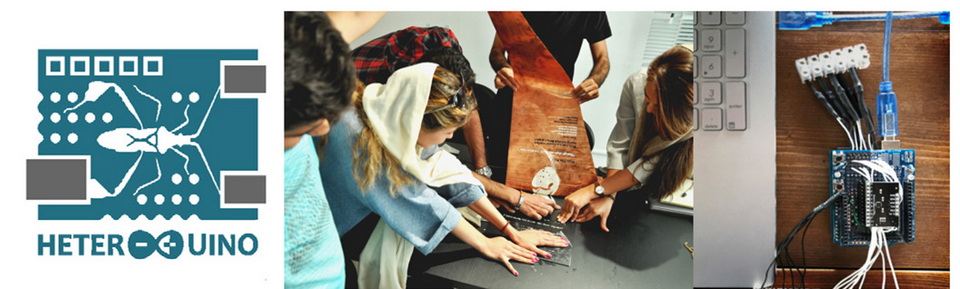
Arduino’s accessibility has made it a valuable tool for artists and architects worldwide. It enables practitioners without extensive prior training in robotics or electronics to investigate their surroundings differently, develop responsive installations, and adapt their own design tools.
Architecture is inherently collaborative and interdisciplinary. Building projects coordinate technologies, trades, markets, regulations, and many forms of expertise. Digital technology continues to expand architectural practice through performance simulation, information modeling, and algorithmic design—methods that require designers to work across multiple disciplines.
The Featured Project#
East 80-08#
East 80-08 imagines a city that responds to its inhabitants. Through gesture, its users can influence the city’s movement, light, and atmosphere, gaining access to its changing pulse. A passage from Italo Calvino’s Invisible Cities frames this speculative relationship between storyteller, city, and listener.
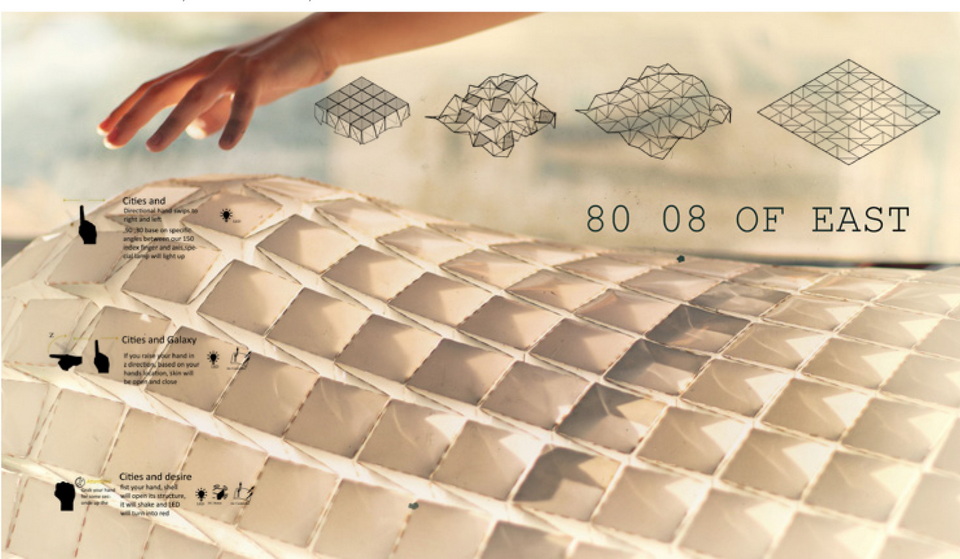
East 80-08 is a fictional city whose form can be transformed through hand gestures. To create its responsive surface, the team tested origami variations and materials within the workshop’s available resources, ultimately selecting an origami system of square subunits.
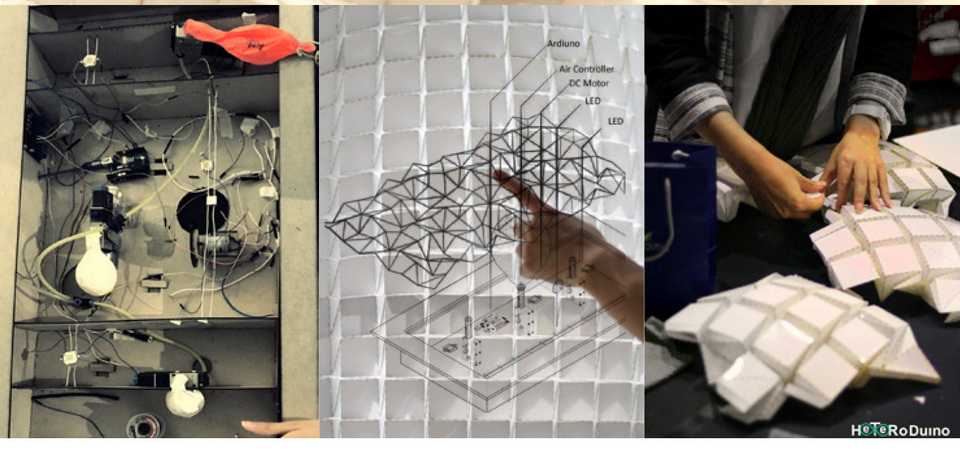
PVC sheet was chosen for the shell because it is flexible, foldable, and retains a material memory. A Leap Motion sensor, Arduino, three air controllers, four LEDs, and a DC motor control its transformation. The actuators are housed beneath the origami shell. Leap Motion reads finger locations as absolute or relative vectors and transmits the data to Grasshopper; Heteroduino then relays the defined commands to the actuators, producing changes through compressors and LEDs.
Team: Sahar Barzani, Parisa Navidi, Faeze Pakravan#
Plum Tree#
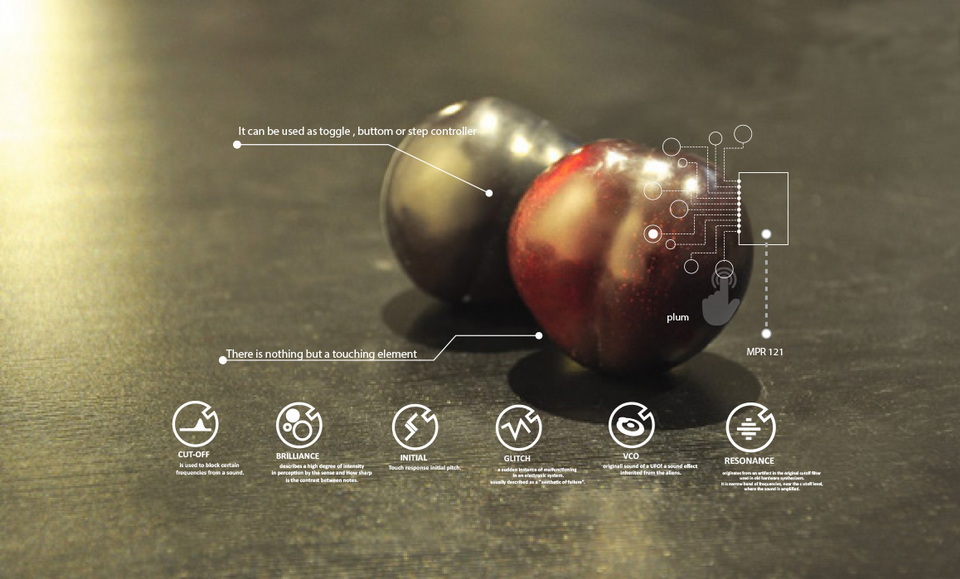
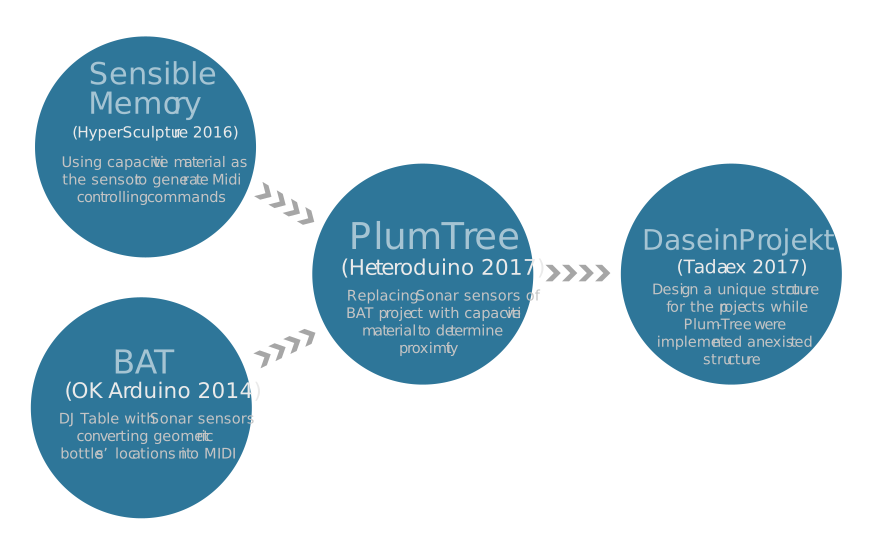
Plum Tree is an interactive instrument that creates a social and spatial musical experience. Building on the Delta-z Project, it adds a new interactive layer to the pavilion. The project uses capacitive sensing to form a three-dimensional MIDI controller without relying on conventional sensor modules. It works through two complementary sensory inputs:
-
Touch sensing: A capacitive touch sensor detects whether the plums have been touched through accumulated electrical charge.
-
Proximity sensing: Capacitive distance sensors use electrical charge gathered in copper planes to register nearby bodies and form a three-dimensional MIDI controller.
The Delta-z project was originally designed as a contemporary public space for CAAI School. Its placement and limited shading, however, reduced interaction with the structure.
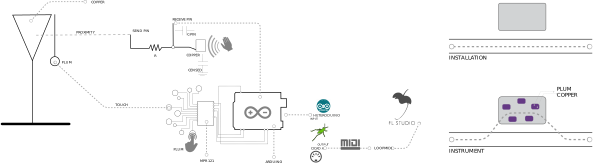
Plum Tree reactivates this underused structure through musical sequences and notes. An Arduino Uno processes electrical charge from the installation as input for Grasshopper. The Heteroptera plugin passes this input to Cicada, a Grasshopper plugin, before the data enters a MIDI loop for mixing and composition in FL Studio.
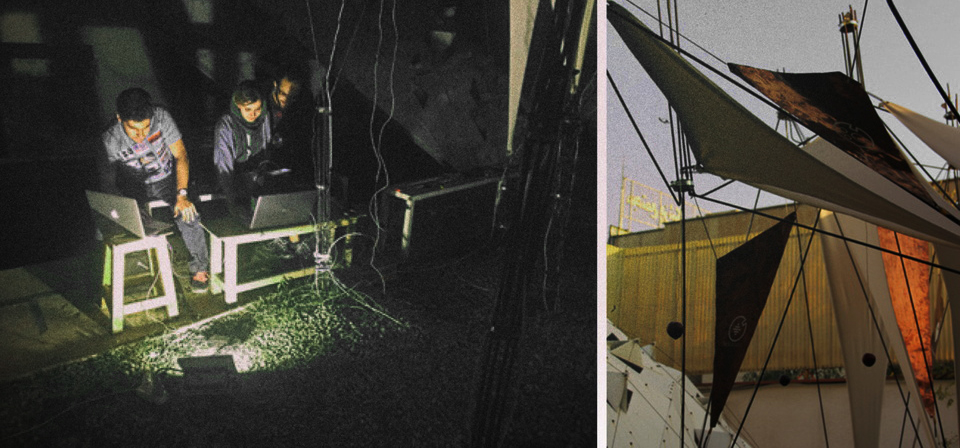
The project demonstrates how music can animate residual space and encourage interaction with existing architecture. With music as its active core, Plum Tree registers movement, touch, and presence through capacitive sensing. It can serve as a platform for instrumentalists, composers, and street artists, and its MIDI compatibility allows it to communicate with a broad range of hardware and software. The project draws on the story of Adam and Eve, replacing the forbidden tree with a plum tree that represents inaccessible or untouchable taboos.
Team: Amirhossein Oliaee, Koosha Mirassadollahi, Mahdis Asadabadi, Yasaman Norouzi#
O-Pen#
O-Pen explores the meeting of technology, drawing, and urban space. It considers how digital tools can empower people to create street art and reclaim their surroundings. By linking democracy, art, and technology, the project enables users to draw at any scale on planar walls and share messages with their communities.
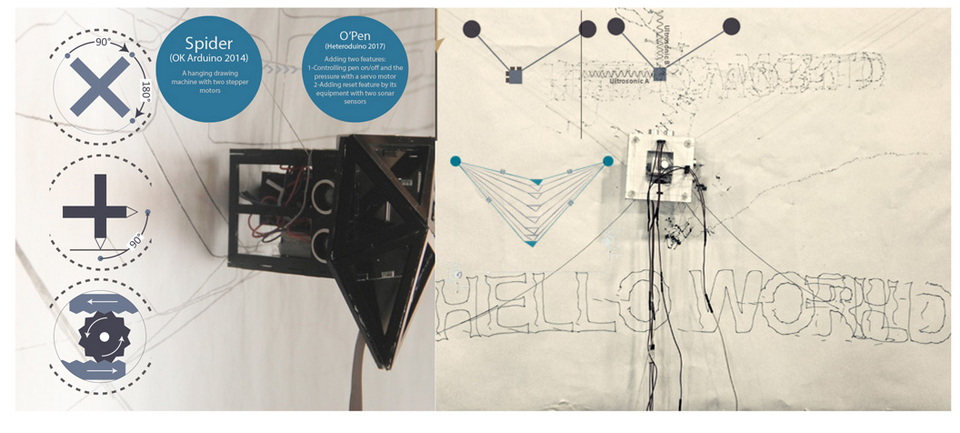
The project extends the Spider Plotter, a wall-plotting system developed from an earlier 2013 project. The Spider Plotter solved the challenge of separating pen and paper at the end of a drawing path. O-Pen broadened its capacity to draw on different surfaces and added sonar sensors to further develop the system.
Extension Projects#
Two workshop projects were submitted to the TADAEX Festival, an annual digital-art festival in Iran held at Mohsen Gallery in Tehran. The festival brings together digital artists from around the world and awards one TadaGrant project while sponsoring one or two additional projects.
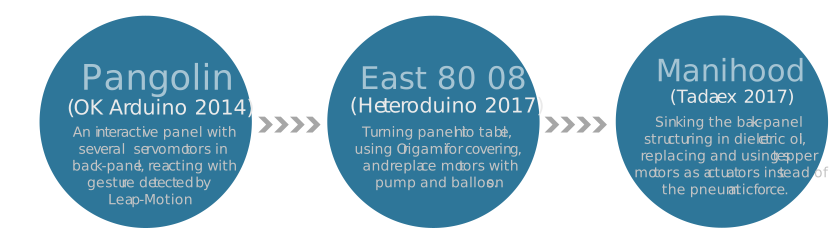
Helioripple teams received both the TadaGrant and TadaFund at TADAEX 2018. Amin Bahrami served as mentor to both teams. By adding sonar sensors to further explore Heteroduino, the teams developed the projects Heteromanous (the TadaGrant) and Heteroganum as extensions of workshop work.
‘Manihood’#
An alternative and extension of the East 80-08 project by the Heteromanus team.
Manihood is a fictional territory shaped by the authority of its rulers. Sign language is the sole means of communication: through gestures, each ruler directs how the land takes form. Indeterminate objects emerge from those choices, and each person’s temporary authority leaves a trace on the territory, including its most concealed layers.
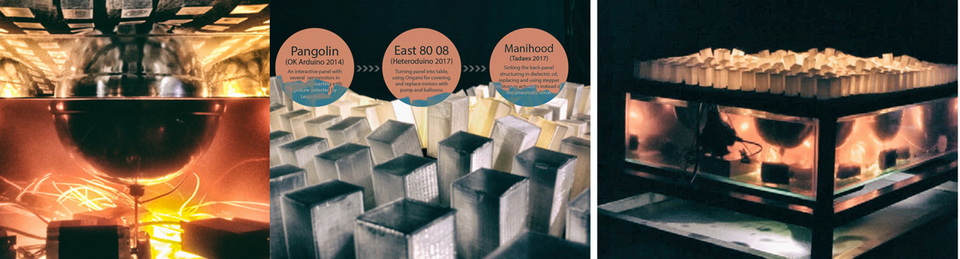
This version focuses on recording transformations made by hand gestures. Each day, a different part of the territory becomes available for construction, unfolding as a puzzle whose final form depends on the scale of public participation. The central technical challenge was to interpret sign language as variables, then develop gestures, materials, and actuators capable of sustaining the resulting changes.
(Faeze Pakravan - Mahdiyar Esmailbeigi - Ladan Johari - Parisa Navidi)#
‘Dasein Projekt’#
An alternative and extension of the Plum Tree project by the Heteroganum team.
Drawing on Heidegger’s concept of Dasein, the project considers being as an experience formed through participation in a shared world. Dasein Projekt is a living musical organism that expresses mood through interaction. It can operate as an installation, an instrument, or a social experiment.
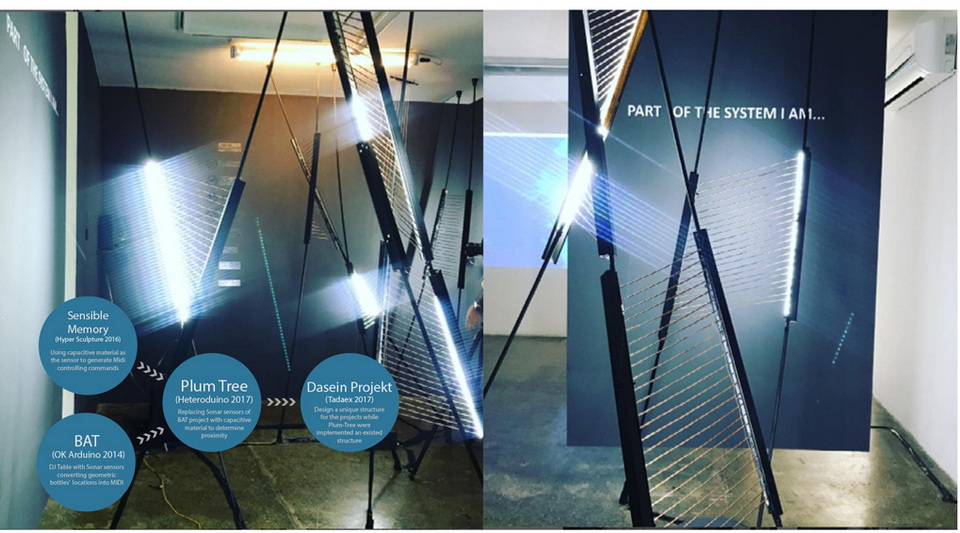
Rather than relying on conventional modes of participation, the installation senses presence without dedicated sensor modules. Microcontrollers create a dynamic capacitive system in which electromagnetic-field intensity between the body and conductive elements forms touch and proximity inputs for a spatial MIDI controller. There are no buttons, keys, or strings: music emerges through exploration of the space, as though it were already present and waiting to be discovered. There is no prescribed method of interaction—mood becomes melody.
Like Plum Tree, the project treats music as the installation’s beating heart. Participants are invited to explore the field around the structure through a simple provocation: “Thou shall not touch the plum tree.” Capacitive sensing detects proximity and touch, allowing the installation to translate individual behavior into sound.