Studio / workshop · 2016
Hyper Sculpture (Iaac GSS/ Tehran)
IAAC Global Summer School at Tehran Urban Innovation Center
The Global Summer School (GSS) is an international platform for ambitious, multi-scalar investigations into the implications of emerging techniques for the built environment. Each year, teams in key cities around the world address a common agenda through projects rooted in their distinct local conditions.
HyperSculptures was developed during Global Summer School 2016, a full-time, two-week initiative launched by the Institute for Advanced Architecture of Catalonia (IAAC) and delivered across a global network of cities. The 2016 program connected participants in Barcelona, New York City, Moscow, Beirut, Beijing, Monterrey, Mumbai, and Tehran, creating an international laboratory in which locally derived design hypotheses could be compared, tested, and evolved across different contexts. The course connected participants to research in robotics, simulation, physical computing, parametric design, digital fabrication, and related emerging methodologies.
Agenda#
The ways cities are described and understood are changing alongside the tools used to design them. This shift calls for multi-scalar strategies for urban design and planning. Networked ecologies—telematic, physical, and social—are a dominant organizational form, producing complexity through technology, law, politics, disciplinary ambition, environmental constraints, and social interaction. Cities can therefore be understood as co-dependent systems of environmental mitigation, land-use organization, communication, and service delivery.
The workshop examined how these networks can operate both within and between cities, forming dynamic and interactive hypercities in which digital and analog sensors process and transmit information. Understanding such interconnected urban phenomena requires carefully designed tools. Accessible data-collection devices, algorithmic modeling, and digital fabrication make it possible to move beyond data visualization toward data physicalization.
HyperSculptures investigated the sequence of data collection, analysis, visualization, and physicalization, emphasizing the contribution of digital-fabrication methods. The resulting data sculptures were MyCityBit, Sensible Memories, and Voxel City.
The Projects#
Sensible Memories#
This project reconsidered the representation of collected data through both digital and physical media, challenging conventional visualization methods. Students worked in three groups to gather data from nine locations across the city. On a city map, copper rods materialized the level and frequency of environmental sound. When visitors touched the rods, the installation played the soundscape of each location while projecting temperature, humidity, and CO2 data onto the map. Together, these representations constructed a memory of each site. The installation treats the city as a platform of overlapping data layers and allows visitors to sense them through combined physical and digital interfaces.

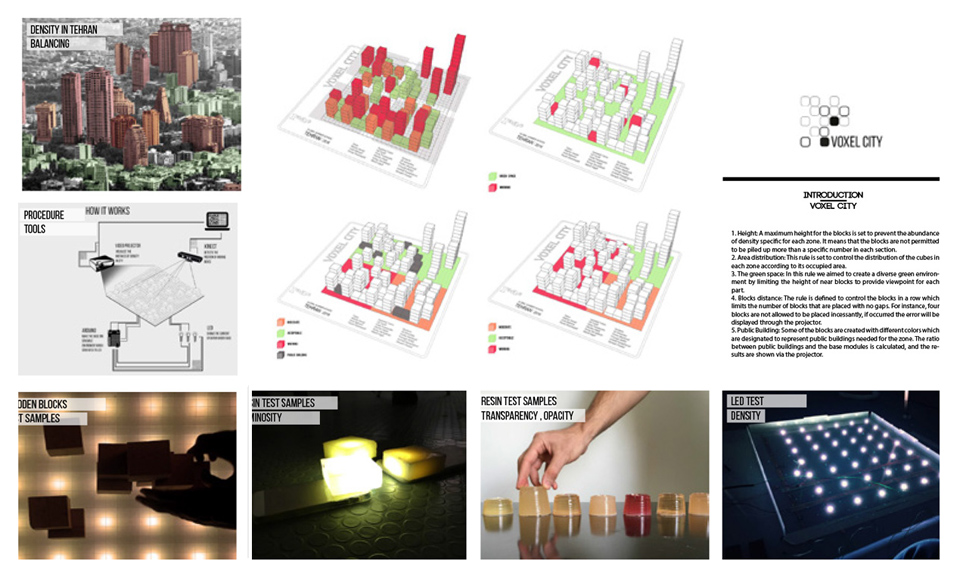
- Height: A maximum block height prevents excessive density within each zone.
- Area distribution: This rule regulates the placement of cubes according to the area they occupy.
- Green space: Limiting the height of adjacent blocks creates a more varied green environment and preserves views.
- Block distance: This rule prevents uninterrupted runs of blocks; for example, four blocks cannot be placed continuously. Violations are indicated by the projector.
- Public buildings: Differently colored blocks represent required public buildings. The ratio of public buildings to base modules is calculated and projected.
STUDENTS: Forough Mofidi Fariba Mashhadi AmirAli Razaghipour Siavash Rezaei Ali Ahmadian#
Voxel City#
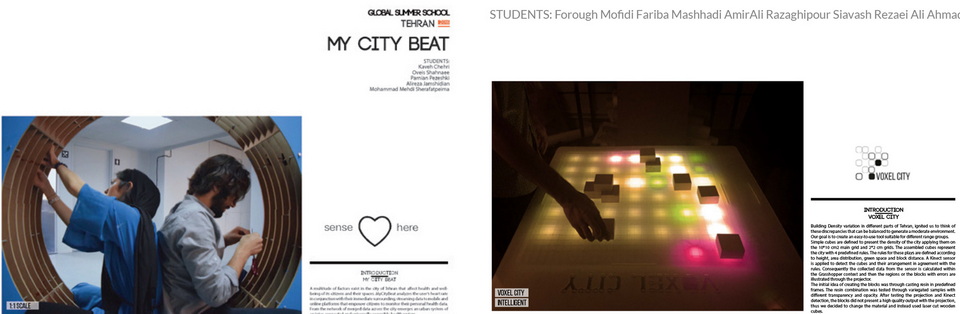
Variations in Tehran’s building density prompted an investigation into how these discrepancies might be balanced to create a more equitable urban environment. The team developed an accessible tool in which simple cubes represent density on a 10 × 10 cm primary grid with 2 × 2 cm subdivisions. The assembled cubes model the city according to four rules: height, area distribution, green space, and block distance. A Kinect sensor detects the arrangement; Grasshopper evaluates the data and a projector highlights noncompliant regions or blocks. The team initially tested resin blocks in frames with different levels of transparency and opacity. Because they performed poorly with projection and Kinect detection, the final blocks were made from laser-cut wooden components.
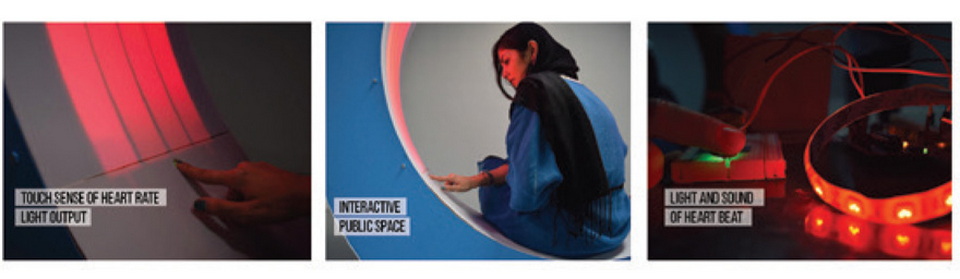
My City Beat#
Many conditions in Tehran affect the health and well-being of residents and their environments. CityBeat analyzes a user’s heart rate alongside immediate environmental conditions, then streams the data to mobile and online platforms that support personal health monitoring. Aggregated citywide data proposes an interconnected, widely accessible urban health system.