Studio / workshop · 2014
Ok Arduino
Arduino and interactive-design workshop at Matn-Emrooz Gallery, led by Helioripple
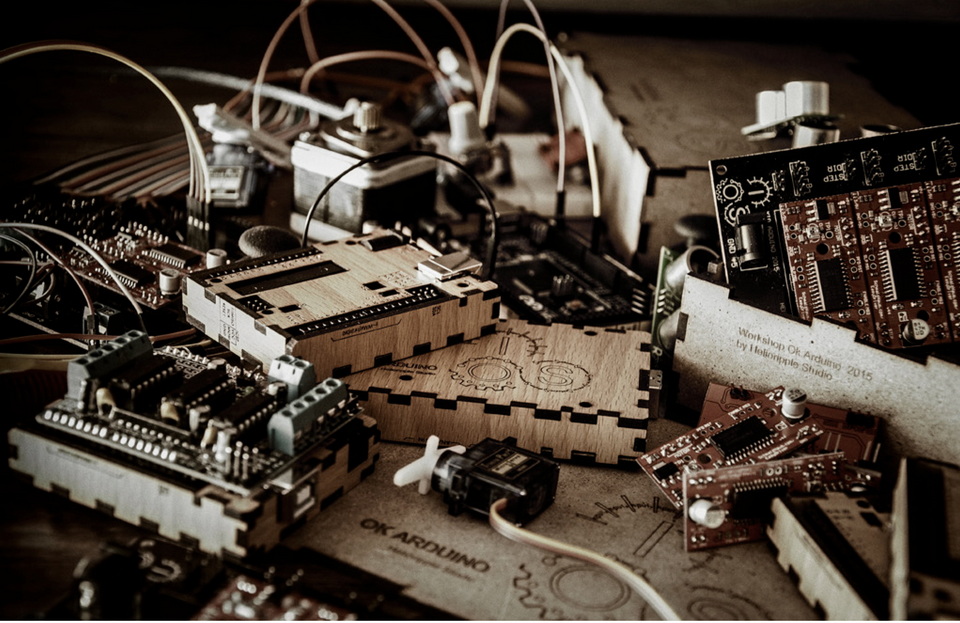
Ok-Arduino was Isfahan’s first Arduino workshop and a starting point for the development of the Cicada and Heteroduino plugins. Held at Matn Gallery in late 2014 under Helioripple’s supervision, it invited undergraduate architecture students to design and build interactive interfaces between people and space. Participants combined images, video, sound, sensors, and actuators to produce digital-art installations using Arduino. Most arrived with limited experience in electronics or computation, so the workshop began with Grasshopper as an interface to Rhino and was shaped by Helioripple—Amin Bahrami and Mobasher Nekouei.
Arduino is a physical-computing platform based on a simple microcontroller board. It enables devices to sense physical surroundings and respond through lights, motors, pumps, switches, and other actuators. Its development environment also allows users to tailor behavior to specific applications. Arduino’s accessibility has made it useful to artists and architects who wish to investigate responsive environments or create customized design tools without advanced prior training in robotics or electronics.
To make Arduino more accessible to architects, Helioripple Studio created Heteroduino, a Grasshopper interface plugin that streamlines communication with Arduino and related microcontrollers through Rhino and Grasshopper. The workshop used a beta release with project-specific experimental features. Under the Helioripple team’s supervision, students explored digital logic, physical space, and architectural intervention through microcontrollers, then developed prototypes using Heteroduino as the bridge between Grasshopper and Arduino.
The Projects#
Bat (Midi Table)#
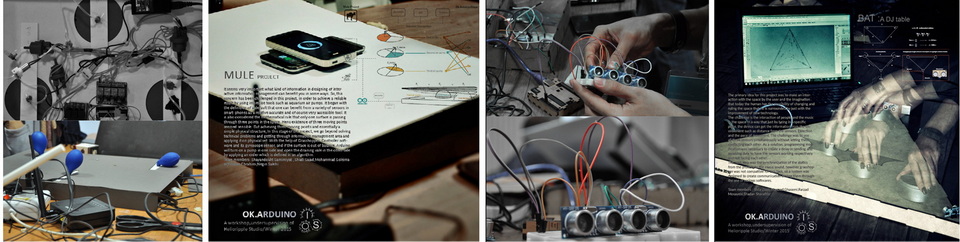
Bat imagines music that responds to movement rather than requiring movement to follow music. The project investigates how software, hardware, robotics, electronics, and mechanics can expand architecture’s capacity to create responsive spatial experiences. A triangular platform with three distance sensors records position, travel distance, direction, and pace of movement. An Arduino processor receives this information through Grasshopper and related software, translating it into changes in musical effects, tone, and tempo.
Each sensor operates as an independent controller. The key technical challenge was coordinating all three without interference, which required programming delays for orderly data transmission and reception. Because Grasshopper alone could not synchronize the sensor data with sound output, the team developed a workflow that connected the required software environments.
Woods (Controller Glove)#
Controlling digital environments with nuanced analog input remains a central challenge. Arduino provides a practical bridge between physical and virtual worlds, accepting a wide range of sensor inputs and producing analog or digital outputs. In Rhinoceros, Grasshopper and Firefly support this connection. This project used analog data from flex sensors to create a more direct relationship between bodily movement and a software environment.
Because the hand is a primary instrument for controlling the environment, the team designed a smart glove to provide more intuitive software control. Flex sensors embedded beneath the fingers transmit continuous analog data as the fingers bend. Given the workshop’s time constraints, the prototype used three fingers: each controlled one continuous function, such as twisting, bending, or changing the width, length, or height of a volume.
The system can be expanded for different spatial and digital applications. Its ability to receive analog and digital input could support software control as well as physical operations such as shutters, ambient lighting, or heating and cooling. Distinct hand movements can also be mapped to specific commands, demonstrating the glove’s potential as an extensible control interface.
Pangolin (Reactive Wall)#
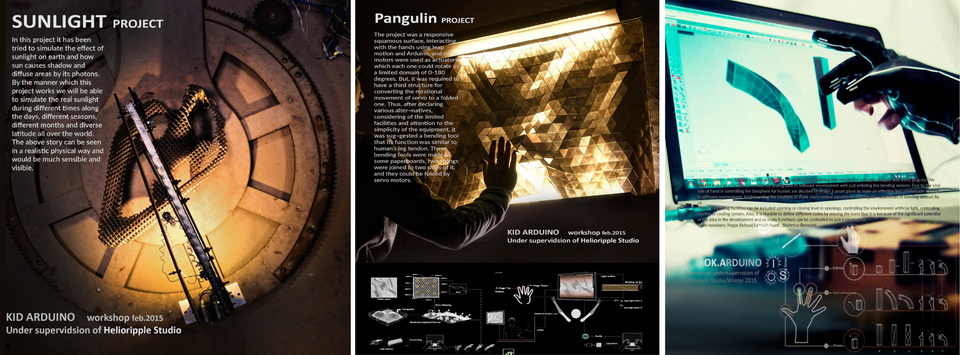
Pangolin investigated whether an accessible Leap Motion sensor could control and reorient a responsive surface. Leap Motion data entered the Grasshopper environment through Firefly for further processing. Because each servo rotates only from 0 to 180 degrees, the central challenge was to create a simple physical system that could be accurately controlled by defined values. The selected solution connected servos to both ends of threads, allowing the panel to form wrinkles as the servos moved.
The project extended beyond mechanical control to the management of sensor data within a physical system. A gyroscope measured the surface’s angle to the Z-axis at four points, allowing the settings to adapt. Arduino activated the servos; when a hand entered the sensing field, Leap Motion interpreted finger movement and the algorithm defined in Grasshopper issued the corresponding command.
Mule (Balance Machine)#
Mule explored how accessible smartphone sensors and inexpensive aquarium air pumps could create a self-leveling surface. A smartphone gyroscope transmitted orientation data to the Grasshopper environment through a mobile controller. Since a plane can be defined by three points in space, the structure used three moving points: three balloon assemblies, each with an inflation pump and an electronic release valve.
The project combined information management with physical actuation. The gyroscope measured the surface’s angle relative to the Z-axis, and Arduino controlled the pumps and valves. When the phone detected that the surface was out of level, a Grasshopper-defined algorithm inflated one side and released air from another until the platform returned to equilibrium.
Galileo Machine(Day-Light Simulator)#
Galileo Machine physically simulates sunlight, including the shadows and diffuse light it produces at different times of day, seasons, dates, and latitudes. Users enter latitude, day of year, and time of day in the “Diva” plugin to calculate the angle between the sun and the earth. That angle is then decomposed into planar and vertical components.
The gear responds to the planar angle and the belt to the vertical angle; together they reproduce the sun’s position and its lighting effects. Stepper motors drive both elements under Arduino control. An LED lamp represents sunlight from sunrise to sunset, while Arduino PWM control adjusts light intensity throughout the day. The current prototype is reset manually after each cycle; a future version would use a potentiometer to track both vectors and automatically return the lamp to its starting position.
Spider (Drawing-Machine)#
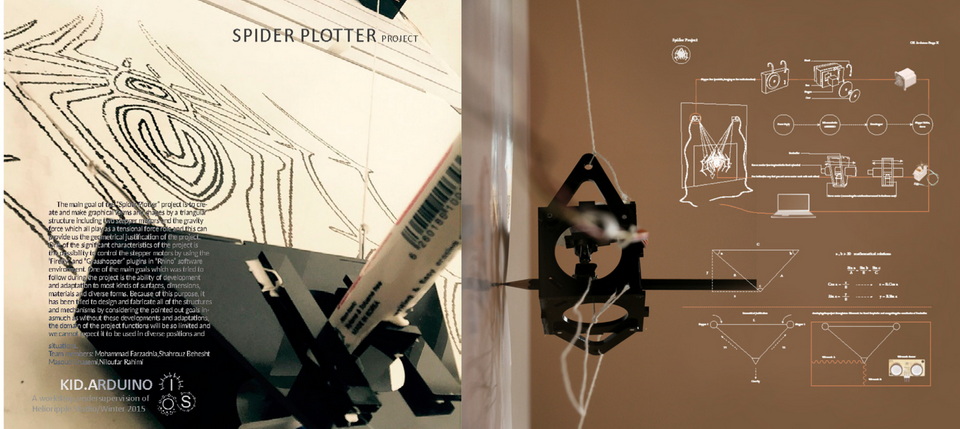
The “Spider Plotter” creates graphical forms through a triangular tension system composed of two stepper motors and gravity. Firefly and Grasshopper in Rhino control the motors. The project was designed to adapt to a wide range of surfaces, dimensions, materials, and drawing conditions. Its first task was the design and fabrication of the common joint elements positioned at the upper corners of the vertical drawing surface.
These elements house the stepper motors and counteract the pen holder’s gravitational load. They can attach to corners by suction, edge hooks, or spike hangers, allowing the plotter to adapt to different sites. Designing the pen holder required precise control of weight distribution and the center of force: any miscalculation would prevent the pen from maintaining contact with the surface. The team also designed a mechanism for exchanging drawing tools. Key challenges included the joints, pen holder, rope offset from the surface, servo placement for lifting the pen, pen dimensions, motor gears, and the rope connection points.
After resolving the structural issues, the team defined the plotter’s control system in Rhino using Firefly and Grasshopper. This required correlating motor rotation, step angle, rope displacement, force-vector decomposition, and the synchronization of physical motion with software definitions. The Spider Plotter can draw text and graphics on vertical surfaces ranging from shop windows and interior walls to large building facades. It can be programmed for outputs ranging from simple words to complex figures, and its compact components can be carried, assembled, and disassembled by one person in a short time.